
H2E Carbon Cleaning Machines
In the car world, few things can affect engine performance like carbon build-up. Deposits build up inside the engine over the years – on the valves, in the combustion chamber and even in the turbines – and affect the power, fuel consumption and even the reliability of the vehicle itself.
For over 15 years, the H2E interdisciplinary team has explored how electrolysis can be applied in the automotive sector.
A patented solution was created to generate an ideal volume and composition of gas suitable for all internal combustion (IC) engines. H2E is the sole method, scientifically verified and entirely safe, for using hydrogen and oxygen gas in IC engine treatment.
Large Electrolyzer in a Compact Housing
H2E treatment uses ionized hydrogen and oxygen in a gaseous state. The gas is obtained with higher voltage and lower current per surface area, unlike all known solutions on the market. That’s why H2E cleans more efficiently and creates a DLC nano-film that reduces friction in the cylinder.
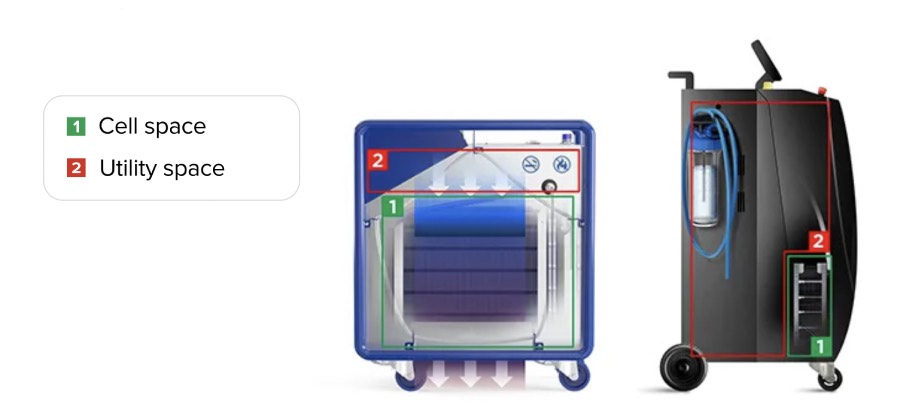
As illustrated in the image below, our competition uses a large box with a smaller electrolyzer (machine to the right), while the ratio of useful electrode surface area to housing volume in our machines is 10x better. Simply put, our electrolyzer is much bigger, which translates into larger cleaning capacity, stability, and consistency.
What H2E Engine Carbon Cleaning Actually Does?
H2E engine carbon cleaning works inside the combustion space, where carbon deposits form naturally during engine operation.
The treatment:
- reduces carbon buildup
- stabilizes combustion
- improves airflow through the engine
- reduces internal friction
As a result, workshops consistently observe:
- smoother engine operation
- improved throttle response
- easier acceleration
- more stable idle
At the same time, cleaner combustion leads to measurable improvements in exhaust emissions, including:
- lower CO (carbon monoxide)
- lower HC (unburned hydrocarbons)
- lower NOx (nitrogen oxides)
- reduced PM / soot particles (PM2.5, PM10)
- visibly reduced smoke and opacity
This is why H2E is used primarily as regular preventive maintenance, not only as a last-resort solution.
Why Emission-Related Problems Start in the Engine?
Many exhaust system problems do not originate in the exhaust itself.
Carbon deposits in the combustion space lead to:
- incomplete combustion
- increased soot formation
- higher exhaust gas contamination
These particles then contaminate:
- turbochargers
- EGR valves
- lambda and NOx sensors
- differential pressure sensors
- catalytic converters
- DPF filters
By improving combustion quality at the source, H2E engine carbon cleaning helps slow down contamination across the entire exhaust system.
Regular Maintenance First – Problem Solving When Needed
In daily workshop practice, H2E machines are most often used for:
- regular preventive treatments
- vehicles driven mainly in urban conditions
- high-mileage vehicles
When a vehicle already shows symptoms such as:
- increased smoke
- emission warnings
- rough running
- early DPF or EGR issues
H2E engine carbon cleaning is usually the first logical step.
If the issue is in an early stage, the treatment may reduce or resolve it.
If not, H2E becomes a powerful support tool for:
- chemical exhaust cleaning
- mechanical or manual DPF cleaning
- flushing procedures
After any repair or cleaning, an H2E treatment:
- delivers an additional measurable effect
- slows down re-contamination
- helps extend the life of repaired or replaced components
Nothing is wasted.
Full Specification List
Swipe left/right to compare →
| Features | H2E Ultra SE | H2E Ultra ECO | H2E Ultra (HD) |
|---|---|---|---|
| Smart automated treatment | Yes | Yes | Yes |
| Pro treatment (adjustable intensity and duration) | Yes | Yes | Yes |
| Quick Pro treatment | No | No | Yes |
| Heavy Duty Housing | Optional | Yes | Yes |
| H2E Android App / iOS | Yes / No | Yes / Optional | Yes / Optional |
| PDF treatment report | No | Optional | Optional |
| Online monitoring | No | Yes | Yes |
| BT / WiFi | Yes / No | Yes / Optional | Yes / Optional |
| Treatment duration (min) | ~40 | 30–60 | 30–120 |
| Type of H2E Electrolyzer | 36 Zero Current Leak Cell | 54 ZCLC + Tensioning System | 54 ZCLC + Tensioning System |
| Service interval (months/treatments) | 12 / 160 | 12 / 200 | 12 / 200 |
| Ultrasound enhanced electrolysis | No | No | Yes |
| H2E DLC electrolyte (g/h) | 200–750 | 150–650 | 200–950 |
| Uniform air cooling of electrodes | 200 m³/h | 300 m³/h | 400 m³/h |
| Maximum power | 16 A / 180–240 VAC | 20 A / 180–240 VAC | 32 A / 180–240 VAC |
| Dimensions (H/W/D) mm | 990 / 360 / 460 | 1050 / 360 / 460 | 1050 / 360 / 460 |
| Net weight (kg) | 85 | 95 | 95 (99 – HD) |
| Warranty (months) | 24 | 24 | 24 |
| Extended warranty (2+3) | No | Optional | Optional |
| H2E Authorized Partner | No | Optional | Optional |
H2E A-Series Carbon Cleaning Machines Lineup
A-Series machines are designed for auto workshops and service centers that want to offer engine carbon cleaning as a regular, premium service.
All A-Series machines share the same H2E core technology, but differ in flexibility and application range:

H2E Ultra SE
Standard preventive engine carbon cleaning
Ultra SE machine is used primarily for:
- Regular preventive maintenance
- Passenger cars
- Light commercial vehicles
H2E Ultra SE is ideal for workshops that want to introduce H2E as a routine service, similar to oil and filter changes.

H2E Ultra ECO
Adjustable treatments for higher-mileage and urban vehicles
Ultra Eco machine allows technicians to:
-
Extend treatment duration
-
Increase treatment intensity
-
Adapt the process to engine condition
It is commonly used for:
-
Vehicles with higher mileage
-
City-driven vehicles
-
Early-stage emission-related issues

H2E Ultra (HD)
High-performance workshop machine
Ultra is the most powerful standard workshop configuration. In its base form, Ultra is suitable for:
- Passenger cars
- Light commercial vehicles
- Road vehicles and engines up to 16,000 cc
Ultra enables:
- Faster treatments
- Higher daily throughput
- Stronger effects when needed
H2E Ultra also comes in HD variant, which is ideal for engines above 16,000 cc up to 32,000 cc.
H2E C-Series – Systems (continuous-duty operation)
C-Series machines are designed for continuous 24/7 operation in demanding environments. They follow a different usage logic than workshop, A-Series machines.

C 54
Continuous-duty system – up to 6,000 cc
Designed for:
- Passenger cars
- Light commercial vehicles
Key focus:
- Robustness
- Long operating cycles
- System-level operation

C 100
Designed for:
- Trucks, buses and large engines
- Uninterrupted daily operation
Key advantages:
- High autonomy
- Long service intervals
- Optimized for fleet and system use
Effects of H2E Decarbonisation
Independent scientific testing confirmed the effectiveness of each one of our decarbonisation machines and our H2E technology as such.
Post-treatment analysis proved each and every engine became more efficient, cost-effective, and more durable; combined, these improvements lead to the dramatic lowering of operational expenses:
- Up to 80% reduction in maintenance costs for key components (DPF/FAP, EGR, catalyst, turbo, injectors, etc.)
- Fuel consumption decreased by 4 to 15%
- Up to 99% restoration of power and performance
Why H2E delivers stronger and repeatable results
The key difference is not the number of electrodes, but the effective electrolysis surface area.
H2E machines provide:
- 5–10× larger usable electrolysis surface in a compact design
- lower load per surface unit
- stable hydrogen and oxygen production
- consistent gas quality
A larger effective surface means:
- gentler electrolysis
- better gas stability
- no performance drop over time
This is why:
- the first vehicle and the tenth vehicle receive the same effect
- results remain stable after months and years of use
- H2E outperforms non-regulated and copy machines
Why H2E machines?
H2E is a brand that does not just sell devices – but a complete solution! Each machine comes with support, training, warranty, and supreme technology – result of many years of experience and development.
In addition to not using chemicals and not requiring engine disassembly, H2E devices can be used in almost any service, even in mobile units. And, thanks to simple handling, the treatment can be done quickly, allowing your clients to leave with a smile on their face and the engine firing on all cylinders!